
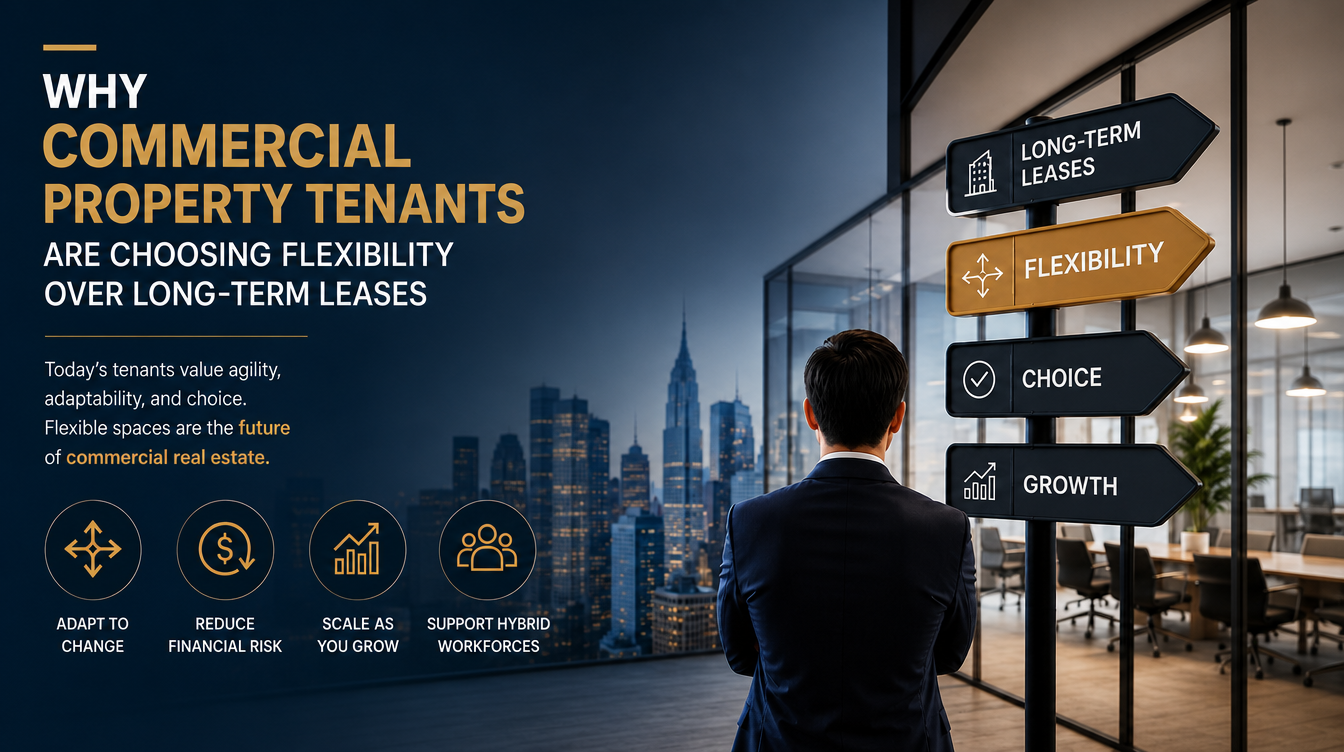
Why Commercial Property Tenants Are Choosing Flexibility Over Long-Term Leases
Australia's commercial real estate market is changing the way businesses think about leasing. While traditional long-term commercial property leases remain common, more tenants are looking for flexible commercial leases that allow them to adapt their property footprint as their business changes. From office space and industrial property to retail and mixed-use developments, flexibility is becoming an increasingly important factor in commercial property Australia.
Why Are Commercial Tenants Seeking More Flexibility?
Business conditions can change quickly.
Companies may expand, reduce their workforce, enter new markets or change how employees use their workplaces. A long-term lease with a fixed footprint can make it difficult and expensive to respond to these changes.
Flexible leasing can provide businesses with greater control over:
- 1. Office space requirements
- 2. Lease duration
- 3. Expansion and contraction
- 4. Workplace configuration
- 5. Operating costs
- 6. Future relocation
Hybrid Work Is Changing Office Leasing
The shift towards hybrid work has had a major impact on office property Australia.
Businesses are increasingly assessing how much office space they actually need rather than automatically leasing large premises for every employee.
Instead, tenants may priorities:
Flexible workspaces that can accommodate changing teams.
Technology-enabled meeting rooms for hybrid teams.
Shared amenities that provide additional value without requiring more leased space.
This is encouraging businesses to focus on the quality and flexibility of commercial office space, rather than simply the number of square meters
Flexibility Is Also Growing in Industrial Property
The demand for flexible leasing isn't limited to offices.
Australia's industrial property market is also evolving as e-commerce, logistics, manufacturing and small businesses create changing space requirements.
Smaller businesses may prefer industrial properties that allow them to expand as their operations grow, while established businesses may value the ability to adjust their footprint as supply chains change.
This is creating demand for more adaptable industrial developments and flexible commercial property solutions.
What Does Flexible Leasing Actually Mean?
It may include:
1. Shorter lease terms
2. Expansion options
3. Contraction rights
4. Break clauses
5. Flexible floorplates
6. Shared amenities
7. Co-working or serviced office arrangements
8. Options to renew or relocate within a property portfolio
The right structure depends on the tenant, property type and landlord's strategy.
Flexibility doesn't necessarily mean a short lease. It can also mean creating options within a longer-term agreement.
What Does This Mean for Landlords?
The rise of flexible leasing creates both opportunities and challenges for commercial property owners in Australia.
Landlords need to balance tenant flexibility with income stability.
A highly flexible lease may appeal to tenants, but landlords still need predictable cash flow and strong occupancy.
This makes tenant experience, building quality and asset management increasingly important.
Properties that can accommodate changing tenant requirements may have an advantage in a competitive leasing market
Flexibility Could Become a Competitive Advantage
Commercial property is no longer simply about providing space.
Businesses increasingly want properties that can adapt alongside their operations.
A building with flexible floorplates, modern infrastructure, shared amenities and strong connectivity can potentially attract a broader range of tenants than a property designed around a single fixed use.
This is particularly relevant as businesses continue to reassess their commercial property strategy.
What Should Commercial Property Investors Watch?
For commercial property investors in Australia, changing tenant preferences could influence how assets are evaluated.
Important factors include:
1. Tenant demand
2. Lease expiry profiles
3. Vacancy rates
4. Building quality
5. Location
6. Adaptability
7. Tenant diversification
8. Rental growth potential
Investors may increasingly need to consider not only who occupies a property today, but how easily the asset can respond to changing tenant requirements tomorrow.
The Future of Commercial Property Leasing in Australia
Long-term leases aren't disappearing. For many businesses and landlords, they will continue to provide valuable stability.
But the Australian commercial real estate market is becoming more flexible.
Tenants want the ability to respond to changing business conditions, while landlords are looking for ways to maintain occupancy and protect long-term asset value.
The commercial properties that can successfully balance stability with flexibility could be better positioned for the future.
The Bottom Line
The future of commercial property leasing in Australia may not be about choosing between a short lease and a long lease.
It may be about creating more options within the lease itself.
As businesses become more agile and workplace requirements continue to evolve, flexibility is becoming an increasingly important part of commercial property strategy.
For tenants, flexibility creates room to grow. For landlords, adaptability could create a stronger competitive advantage.
Related Commercial Property Guides
Mlina Editorial — Mlina Group helps Australians invest in commercial property through buyer advocacy, education, and asset management. Meet our team.
Ready to Take the Next Step?
Learn more about commercial property investment in our upcoming webinar
Join Our Next Webinar