
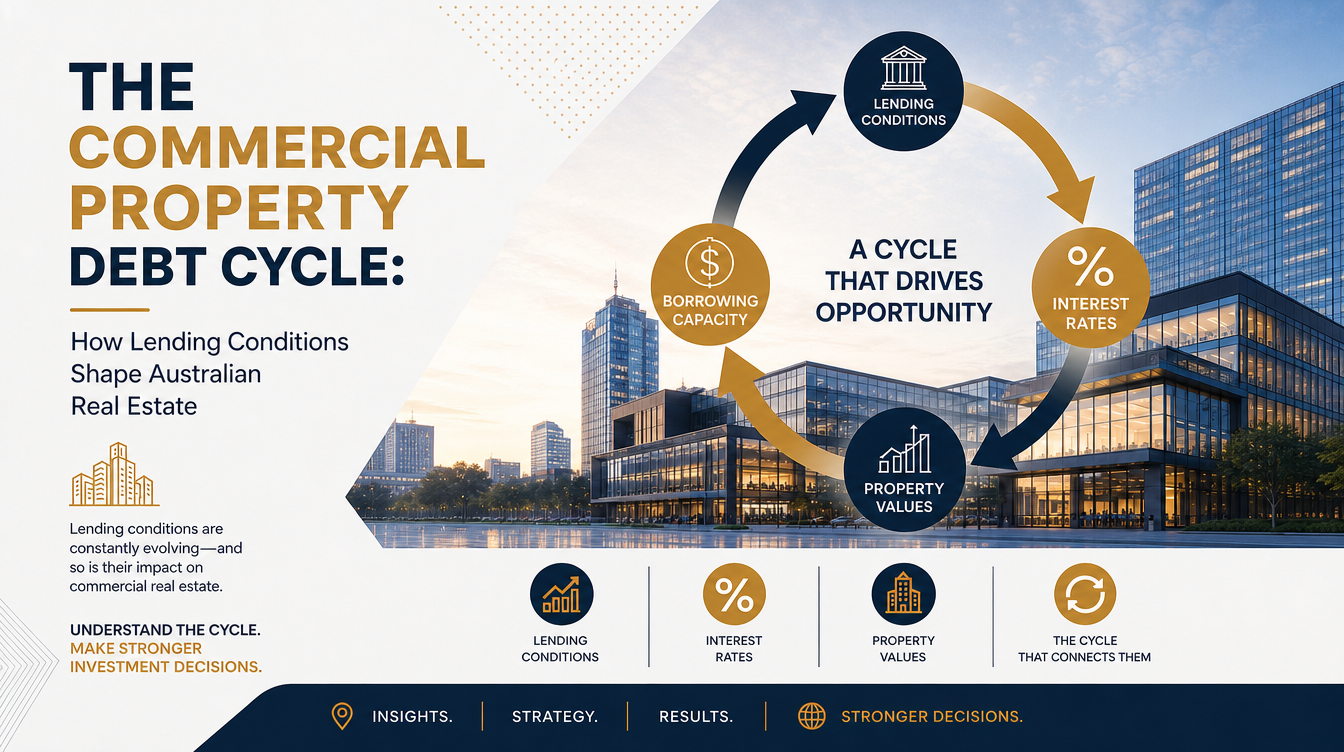
The Commercial Property Debt Cycle: How Lending Conditions Shape Australian Real Estate
The commercial property debt cycle in Australia plays a major role in shaping investment activity, property values and development decisions. When lending conditions are favorable, investors can access capital more easily. When borrowing costs rise or lenders become more cautious, commercial property transactions can slow and investment strategies can change.
What Is the Commercial Property Debt Cycle?
The commercial property debt cycle refers to the way credit availability, interest rates, lending standards and investor demand move through different stages of the property market.
When financing is readily available, investors may have greater capacity to acquire assets, refinance existing debt and fund new developments.
When lending conditions tighten, borrowing becomes more expensive and investors may become more selective.
This can influence the entire commercial property market in Australia.
How Lending Conditions Affect Property Investment
Financing is a major component of commercial property investment.
Changes in borrowing costs can affect:
- 1. Investment returns
- 2. Acquisition prices
- 3. Property valuations
- 4. Development feasibility
- 5. Refinancing decisions
- 6. Investor demand
- 7. Transaction volumes
For example, when interest rates increase, the cost of servicing commercial property debt can rise. Investors may then require stronger rental income or a lower purchase price to achieve their target returns.
Interest Rates and Commercial Property Debt
Interest rates are one of the biggest influences on commercial property finance in Australia.
Higher interest rates can increase debt servicing costs and reduce the amount investors are willing or able to borrow.
Lower rates can have the opposite effect by improving borrowing capacity and making investment opportunities more attractive.
However, interest rates are only one part of the equation.
Lenders also consider factors such as the property's income, valuation, tenant quality, loan-to-value ratio and the borrower's financial position.
When Lending Conditions Tighten
During periods of tighter credit, lenders may become more selective about which projects and assets they finance.
This can lead investors to focus more heavily on properties with:
- 1. Strong and established tenants
- 2. Stable rental income
- 3. High-quality locations
- 4. Lower vacancy risk
- 5. Strong asset fundamentals
For developers, tighter lending conditions can also make construction projects more difficult to finance, particularly when construction costs and project timelines are increasing.
Refinancing Risk Matters
The debt cycle doesn't only affect new purchases.
Existing commercial property owners also need to consider refinancing risk.
When a commercial property loan reaches maturity, the owner may need to refinance at a different interest rate or under different lending conditions.
If the property's income or valuation has changed, refinancing can become more challenging.
This makes debt maturity planning an important part of commercial property investment strategy.
What Happens When Credit Becomes More Available?
When lenders become more willing to provide finance, investment activity can increase.
Greater access to debt can support:
- 1. Property acquisitions
- 2. Commercial developments
- 3. Renovations and upgrades
- 4. Refinancing
- 5. Portfolio expansion
More available capital can also increase competition for high-quality commercial assets.
However, increased access to debt can also encourage investors to take on greater leverage, making risk management particularly important.
The Impact on Commercial Property Values
The relationship between debt and commercial property valuations in Australia is significant.
If borrowing costs rise and investors demand higher returns, the price they are willing to pay for an asset may fall.
On the other hand, improving financing conditions can support stronger investment demand.
This is why changes in lending conditions can influence commercial property values even when the underlying building and rental income haven't changed.
What Should Australian Investors Watch?
Understanding the commercial property debt cycle means looking beyond the headline interest rate.
Investors should monitor:
1. Interest rates — What is the current and expected cost of borrowing?
2. Lending standards — Are banks becoming more selective?
3. Loan maturities — How much debt needs to be refinanced?
4. Property yields — Does the income justify the cost of capital?
5. Tenant strength — How secure is the property's rental income?
6. Valuations — Does the property's current value support the required financing?
These factors can provide a clearer picture of the risks and opportunities within the Australian commercial real estate market.
The Bottom Line
The commercial property debt cycle can influence almost every part of the Australian real estate market from acquisitions and development to valuations and refinancing.
For investors, understanding commercial property finance, lending conditions and debt costs is becoming just as important as understanding the property itself.
The strongest investment decisions aren't simply based on finding a good building.
They are based on understanding how the property, the income and the cost of capital work together.
Related Commercial Property Guides
Mlina Editorial — Mlina Group helps Australians invest in commercial property through buyer advocacy, education, and asset management. Meet our team.
Ready to Take the Next Step?
Learn more about commercial property investment in our upcoming webinar
Join Our Next Webinar