
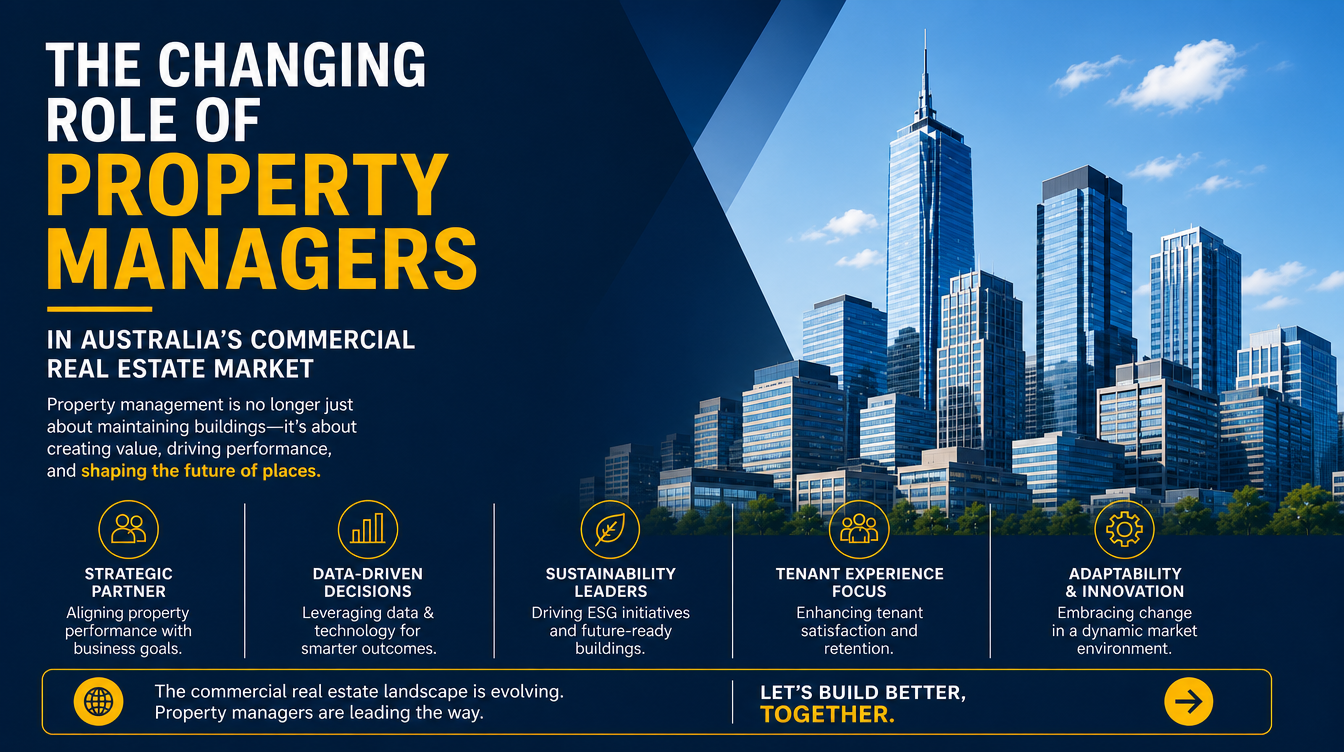
The Changing Role of Property Managers in Australia's Commercial Real Estate Market
The role of a commercial property manager in Australia is changing. Property management is no longer simply about collecting rent, organising maintenance and managing leases. As tenant expectations, technology and operating costs evolve, commercial property managers are becoming an increasingly important part of commercial real estate asset management. For landlords and investors, effective property management can influence tenant retention, operating efficiency and the long-term performance of a commercial property.
What Is Changing in Commercial Property Management?
Australia's commercial real estate market is becoming more complex.
Office, industrial, retail and mixed-use properties all face different tenant requirements, operational challenges and market conditions. At the same time, tenants expect faster communication, better amenities and more responsive building services.
This means commercial property managers are increasingly moving from a reactive role to a more strategic property management approach.
From Property Manager to Asset Partner
Traditionally, commercial property management focused heavily on day-to-day operations.
Today, property managers are increasingly involved in:
1. Tenant retention
2. Lease administration
3. Building performance
4. Operating cost management
5. Maintenance planning
6. Sustainability initiatives
7. Tenant experience
8. Risk management
9. Property technology
10. Asset performance
The role is becoming closely connected to commercial property investment strategy.
Tenant Experience Is Becoming More Important
One of the biggest changes in commercial property Australia is the growing importance of tenant experience.
Businesses are looking for more than four walls and a lease. Office tenants may value quality amenities, technology, wellness facilities and flexible spaces, while industrial tenants may priorities accessibility, loading facilities and efficient building operations.
Property managers are increasingly responsible for understanding these requirements and ensuring that buildings remain competitive.
A well-managed property can help landlords maintain stronger relationships with tenants and potentially improve retention.
Technology Is Transforming Property Management
Technology is also changing commercial property management in Australia.
Property managers can now use digital platforms and building technology to monitor operations, communicate with tenants and track property performance.
Technology can support:
1. Automated maintenance requests — allowing issues to be reported and tracked more efficiently.
2. Building monitoring — helping identify energy and operational inefficiencies.
3. Digital communication — making tenant engagement faster and more transparent.
4. Data analytics — helping owners understand occupancy, operating costs and asset performance.
As commercial buildings become smarter, property managers will increasingly need to understand both real estate and technology.
Sustainability Is Becoming Part of the Job
Sustainability is another area expanding the role of the commercial property manager.
Energy efficiency, waste management, water usage and building performance are becoming increasingly important considerations for owners and tenants.
Property managers may play a role in implementing sustainability initiatives, monitoring building performance and helping landlords understand where operational improvements can create value.
For commercial property investors, better building efficiency can also contribute to stronger operating performance.
Managing Costs Without Compromising Quality
Operating costs are another major priority.
Commercial property owners need to control expenses while maintaining the quality and functionality of their assets.
Property managers can help by reviewing:
1. Building maintenance
2. Energy consumption
3. Cleaning and security contracts
4. Facility management
5. Capital expenditure
6. Preventative maintenance
The objective isn't simply to reduce costs it is to manage costs strategically while protecting the property's long-term value.
Why Tenant Retention Matters?
Tenant turnover can be expensive for commercial property owners.
Vacancies can result in lost rental income, marketing expenses, incentives, refurbishment costs and lengthy leasing periods.
This makes tenant retention in commercial real estate increasingly important.
Property managers are often the first point of contact for tenants, which gives them an important role in identifying concerns before they become reasons to leave.
Strong communication and proactive management can therefore become a competitive advantage.
What Does This Mean for Commercial Property Investors?
For commercial property investors in Australia, property management should be viewed as more than an operational expense.
The quality of property management can influence:
1. Tenant satisfaction
2. Vacancy levels
3. Operating costs
4. Building condition
5. Rental income
6.Asset value
7. Long-term investment performance
As the Australian commercial property market becomes more competitive, effective management can help differentiate one asset from another.
The Future of Commercial Property Management in Australia
The future commercial property manager is likely to be more data-driven, technology-enabled and strategically focused.
Rather than simply responding to problems, property managers will increasingly use data to identify opportunities, anticipate maintenance requirements, improve tenant experiences and support investment decisions.
This shift is particularly important as Australian commercial real estate continues to evolve across office, industrial, retail and mixed-use sectors.
The Bottom Line
The role of the commercial property manager in Australia is no longer limited to managing buildings.
It is increasingly about managing relationships, performance, technology, costs and long-term asset value.
For landlords and investors, the right property management strategy can become an important part of protecting and growing commercial property value.
The future of commercial property management isn't just about keeping buildings running. It's about making them perform better.
Related Commercial Property Guides
Mlina Editorial — Mlina Group helps Australians invest in commercial property through buyer advocacy, education, and asset management. Meet our team.
Ready to Take the Next Step?
Learn more about commercial property investment in our upcoming webinar
Join Our Next Webinar