
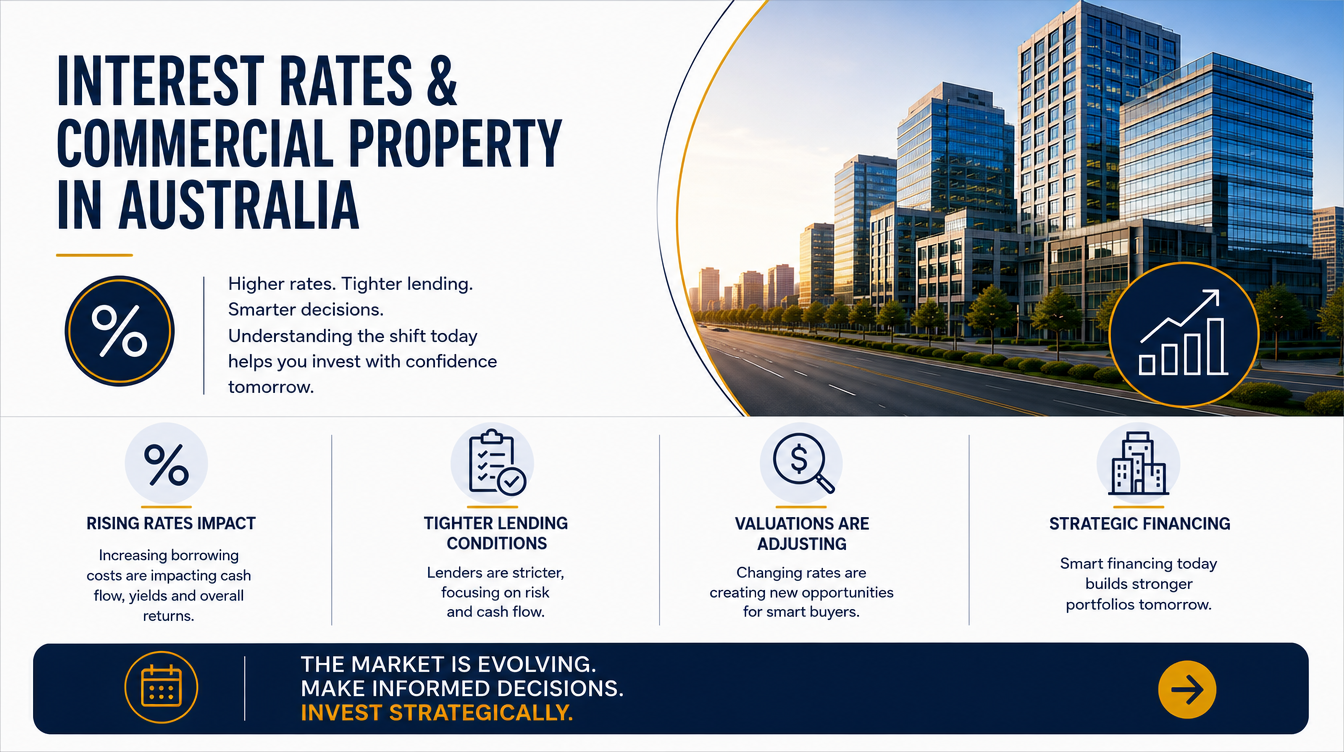
Interest Rates and Commercial Property Australia: How Financing Costs Are Changing Investment Decisions
Interest rates have become an increasingly important factor in commercial property investment in Australia. From office buildings and industrial properties to retail assets and development sites, the cost of finance can influence everything from property valuations to investment returns. For Australian commercial property investors, understanding the relationship between interest rates, borrowing costs and property values is becoming essential.
How Do Interest Rates Affect Commercial Property?
When interest rates rise, the cost of borrowing generally increases. For commercial property investors using debt, this can put pressure on cash flow and reduce the returns generated by an asset.
Higher financing costs can also affect how investors assess new acquisitions. A property that previously looked attractive at a particular purchase price may no longer deliver the same risk-adjusted return when the cost of debt increases.
Financing Costs Are Changing Investment Decisions
Investors also need to consider:
1. Cost of debt
2. Loan-to-value ratio
3. Interest coverage
4.Rental income
5.Operating expenses
6. Capital expenditure
7. Expected rental growth
8. Exit value
When borrowing costs rise, investors may become more selective about which properties meet their return requirements.
This can lead to greater focus on high-quality commercial properties with strong tenants, reliable income and long-term growth potential.
Commercial Property Valuations Can Come Under Pressure
Interest rates can also influence commercial property valuations in Australia.
Commercial properties are commonly valued based on their expected future income.
When financing conditions change and required investment returns increase, the value investors are willing to pay can change as well.
This doesn't mean every commercial property will experience the same impact.
Assets with strong rental growth, high occupancy and attractive locations may be better positioned than properties facing high vacancy or weak tenant demand.
Refinancing Is Becoming More Important
Existing commercial property owners also need to consider refinancing risk.
When a commercial property loan reaches maturity, the cost of replacing that debt may be higher or lower than the original financing arrangement.
This makes commercial property refinancing in Australia an increasingly important part of asset management.
Property owners may need to review:
- 1. Loan maturity dates
- 2. Interest-rate structures
- 3. Debt levels
- 4. Property valuations
- 5. Rental income
- 6. Refinancing requirements
Strong asset performance can become particularly important when lenders assess refinancing opportunities.
Lenders Are Looking Closely at Asset Performance
Higher financing costs can also change the relationship between lenders and borrowers.
Recent Australian lender sentiment research found that while appetite for commercial real estate lending remained positive, lenders were becoming more focused on performance-based factors when considering refinancing.
This means property fundamentals matter.
A strong tenant profile, stable rental income and well-performing asset can provide a stronger foundation when seeking finance.
Not Every Commercial Property Is Affected Equally
One of the most important points for commercial property investors in Australia is that interest rates don't affect every asset in exactly the same way.
Different sectors have different fundamentals.
1. Industrial Property
Strong demand for logistics, warehousing and specialized facilities can support rental growth and investor interest.
2. Office Property
Tenant demand, building quality, location and workplace trends can have a major influence on performance.
3. Retail Property
Tenant strength, consumer activity, location and shopping-center performance remain important considerations.
4. Development Property
Development projects can be particularly sensitive to financing costs because higher interest expenses can increase the overall cost of delivering a project.
The Importance of Yield and Debt
For investors, one of the key considerations is the relationship between property yield and the cost of debt.
If financing becomes more expensive while property income remains unchanged, the spread between investment income and borrowing costs can become narrower.
This can influence whether investors decide to:
Buy : if the asset still offers an attractive risk-adjusted return.
Renegotiate : if the price needs to change to make the numbers work.
Wait : if market conditions don't currently support the required return.
This is why interest rates can influence transaction activity even when underlying property demand remains relatively strong.
What Should Commercial Property Investors Watch?
Investors evaluating commercial real estate investment in Australia should look beyond the headline interest rate.
Key indicators include:
- 1. Rental growth
- 2. Vacancy rates
- 3. Tenant quality
- 4. Debt maturity
- 5. Loan-to-value ratios
- 6. Property yields
- 7. Capital expenditure
- 8. Development pipeline
- 9. Local market fundamentals
The strongest investment decisions typically come from understanding how these factors interact rather than focusing on one metric.
The Bottom Line
Interest rates and commercial property Australia are closely connected.
Higher financing costs can affect borrowing capacity, investment returns, valuations and development feasibility.
But they can also create opportunities for investors who understand property fundamentals and can identify assets with strong income potential.
For today's commercial property investor, the question isn't simply:
“What is the interest rate?”
It's:
“Does this property still make financial sense at today's cost of capital?”
That shift in thinking could become increasingly important as Australia's commercial real estate market enters its next phase.
Related Commercial Property Guides
Mlina Editorial — Mlina Group helps Australians invest in commercial property through buyer advocacy, education, and asset management. Meet our team.
Ready to Take the Next Step?
Learn more about commercial property investment in our upcoming webinar
Join Our Next Webinar