
How to Calculate ROI on Commercial Property: A Step-by-Step Guide
For any commercial real estate investor, the critical question is: "Is my money working hard enough?" We explain how to calculate Return on Investment (ROI) step-by-step so you can compare assets and make data-driven decisions.
Introduction
For any commercial real estate investor, the most critical question is: "Is my money working hard enough?" While rental income is great, it doesn’t tell the whole story. To understand the true performance of your asset, you need to calculate your Return on Investment (ROI).
This metric allows you to compare a warehouse in the suburbs to a retail shop in the city—or even to the stock market—on a level playing field.
What is ROI in Commercial Real Estate?
ROI measures the annual profit of an investment as a percentage of its total cost. Unlike "yield," which often just looks at the property price, ROI considers every dollar you spent to get the deal done.
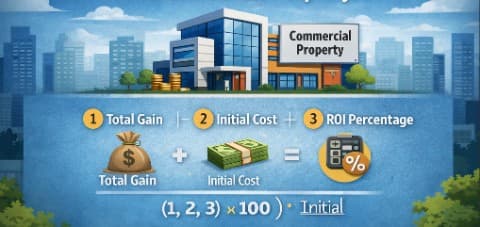
The Master ROI Formula:
ROI = (Annual net income / total investment cost) X 100
Step 1: Determine Your Annual Net Income
Before you can find your ROI, you need to know your "bottom line." Start with your gross annual rent and subtract every operating expense.
Common expenses include:
- Property Management Fees: Usually a percentage of the rent.
- Maintenance & Repairs: Budgeting for both minor fixes and long-term capital expenditure.
- Insurance & Taxes: Rates, land tax, and building insurance.
- Vacancy Allowance: A "buffer" for the months the property might sit empty between tenants.
Step 2: Calculate Total Investment Cost
This is where many beginners stumble. ROI isn’t just based on the purchase price; it’s based on the total capital outlaid.
Your total cost includes:
- Purchase Price: The agreed-upon cost of the property.
- Acquisition Costs: Stamp duty, legal fees, and building inspections.
- Renovations: Any "fit-out" costs or immediate repairs needed to make the property tenant-ready.
- Closing Costs: Loan application fees and settlement costs.
Step 3: Putting It All Together (The Example)
Let’s look at a real-world scenario to see how the numbers shift:
- Purchase Price: $950,000
- Closing Costs & Stamp Duty: $50,000
- Total Investment Cost: $1,000,000
- Annual Rental Income: $100,000
- Annual Operating Expenses: $30,000
- Annual Net Income: $70,000
The Calculation:
ROI = (70,000 / 1,000,000) X 100 = 7%
Why ROI is the Ultimate Decision-Maker
Calculating ROI helps you move past "gut feelings" and make data-driven decisions. It is essential for:
- Comparing Assets: Should you buy one $2M office or two $1M industrial units? ROI gives you the answer.
- Assessing Risk: If a property has a high ROI but high vacancy risk, you can decide if the return justifies the danger.
- Portfolio Benchmarking: Comparing your real estate performance against other asset classes like shares or bonds.
Expert Tip: ROI vs. Cash-on-Cash Return
While ROI looks at the total value, many commercial investors also calculate Cash-on-Cash Return. This measures the return on the actual cash you personally put in (your deposit) rather than the total value of the property including the bank loan.
Final Thoughts
A strong ROI isn’t just about high rent; it’s about cost control. By minimizing vacancies and managing operating expenses tightly, you can significantly boost your ROI without ever raising the rent.
Related Commercial Property Guides
Mlina — Mlina Group helps Australians invest in commercial property through buyer advocacy, education, and asset management. Meet our team.
Ready to Take the Next Step?
Learn more about commercial property investment in our upcoming webinar
Join Our Next Webinar