
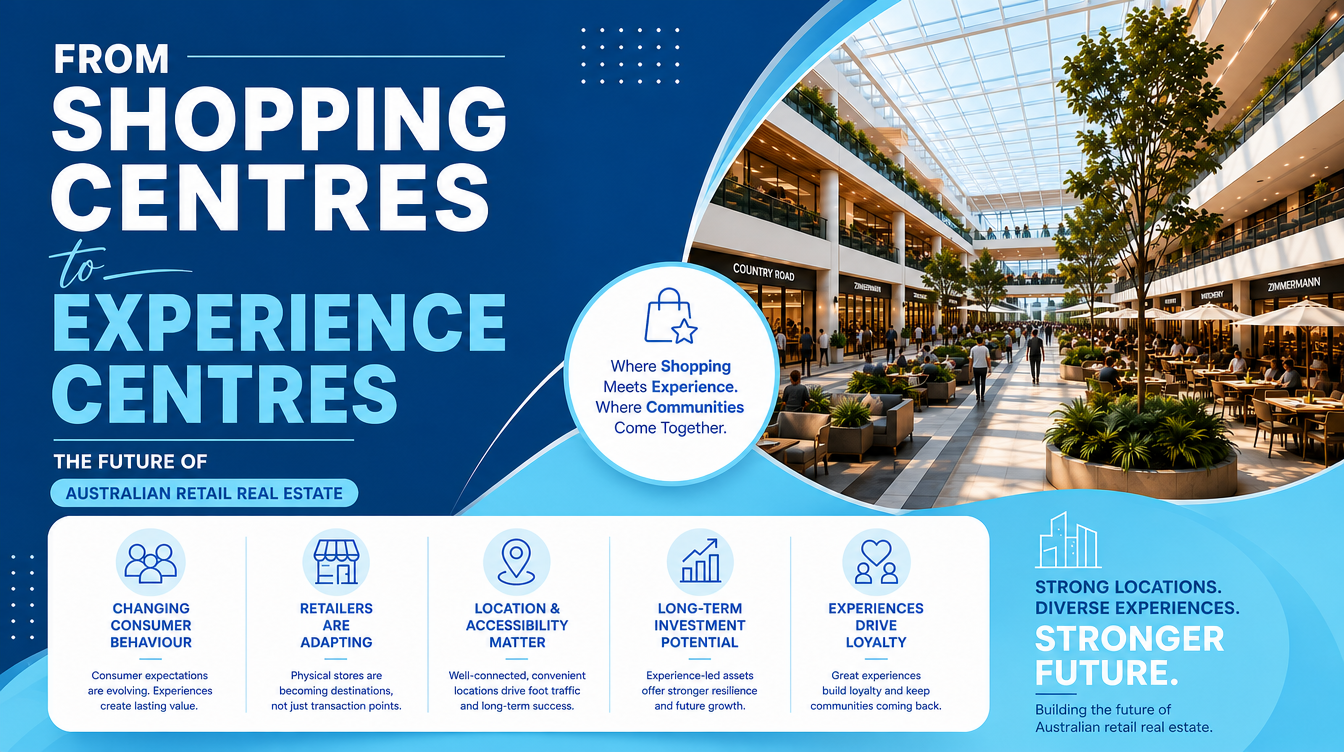
From Shopping Centers to Experience Centers: The Future of Australian Retail Real Estate
Australia's retail real estate market is changing. Shopping centres are no longer competing only on the number of stores they offer—they are increasingly competing on the experience they create. As online shopping becomes part of everyday life, physical retail needs to offer something digital platforms cannot: connection, entertainment, convenience and experiences. This shift is transforming traditional shopping centres into experience destinations.
The Evolution of Australian Shopping Centers
The traditional shopping center was built around retail transactions. Today, successful centres are becoming places where people can shop, dine, work, exercise, socialize and spend time.
Retailers remain important, but they are increasingly being supported by a broader mix of uses, including:
1. Restaurants and café
2. Entertainment and cinemas
3. Fitness and wellness
4.Healthcare and medical services
5.Beauty and personal care
6. Community spaces
7. Events and experiences
This diversification is helping shopping centres remain relevant in a changing retail environment.
Why Experience Matters
Consumers can purchase almost anything online. What they cannot replicate as easily is the experience of physically visiting a destination.
A successful retail centre can create value through:
Food & dining — Restaurants and cafés encourage visitors to stay longer.
Entertainment — Cinemas, activities and events create reasons to visit beyond shopping.
Wellness — Fitness, healthcare and lifestyle services create regular foot traffic.
Community — Events and social spaces turn retail centres into local destinations.
The result is a shift from transaction-focused retail to experience-focused real estate.
Retailers Are Changing Too
The evolution isn't only happening at the property level.
Retailers are increasingly using physical stores as part of a broader customer experience. Stores can function as showrooms, service centres, collection points and brand experiences rather than simply places where customers make purchases.
This creates new opportunities for landlords to think differently about tenant mix and leasing strategies.
The Importance of Tenant Mix
A strong tenant mix is becoming one of the most important factors in successful Australian retail property.
A centre with only traditional retail stores may struggle to create frequent visits. A diversified centre can attract different customer groups throughout the week.
For example, a visitor might come for:
Monday: Gym
Wednesday: Medical appointment
Friday: Dinner
Saturday: Shopping and entertainment
This creates more consistent foot traffic and can strengthen the overall performance of the retail destination.
Location Still Matters
Despite the evolution of retail, one fundamental principle remains: location matters.
But the definition of a good retail location is becoming broader.
Successful centres need to be accessible to growing populations, connected to transport networks and positioned within communities where people live, work and spend their leisure time.
Population growth and urban development can therefore create new opportunities for retail property investment outside traditional CBD locations.
What This Means for Investors
The changing retail environment creates both challenges and opportunities for commercial property investors in Australia.
Investors are increasingly looking beyond rental income and considering:
- Tenant quality
- Customer experience
- Foot traffic
- Tenant diversity
- Location
- Development potential
- Long-term adaptability
Retail assets that can evolve with changing consumer behavior may be better positioned to maintain their relevance over the long term.
The Future of Retail Real Estate
The future Australian shopping centre may look very different from the traditional mall.
It could be part retail destination, part dining precinct, part entertainment hub and part community space.
The strongest assets may not simply be the ones with the most shops, but the ones that give consumers the most reasons to visit.
The Bottom Line
Online shopping hasn't eliminated physical retail—it has forced it to evolve.
Australia's retail real estate market is moving from shopping centres to experience centres, where retail is combined with dining, entertainment, wellness, healthcare and community.
For landlords, developers and investors, the opportunity lies in creating destinations that people don't simply need to visit they want to visit.
The future of retail isn't just about what you can buy. It's about what you can experience.
Related Commercial Property Guides
Mlina Editorial — Mlina Group helps Australians invest in commercial property through buyer advocacy, education, and asset management. Meet our team.
Ready to Take the Next Step?
Learn more about commercial property investment in our upcoming webinar
Join Our Next Webinar