
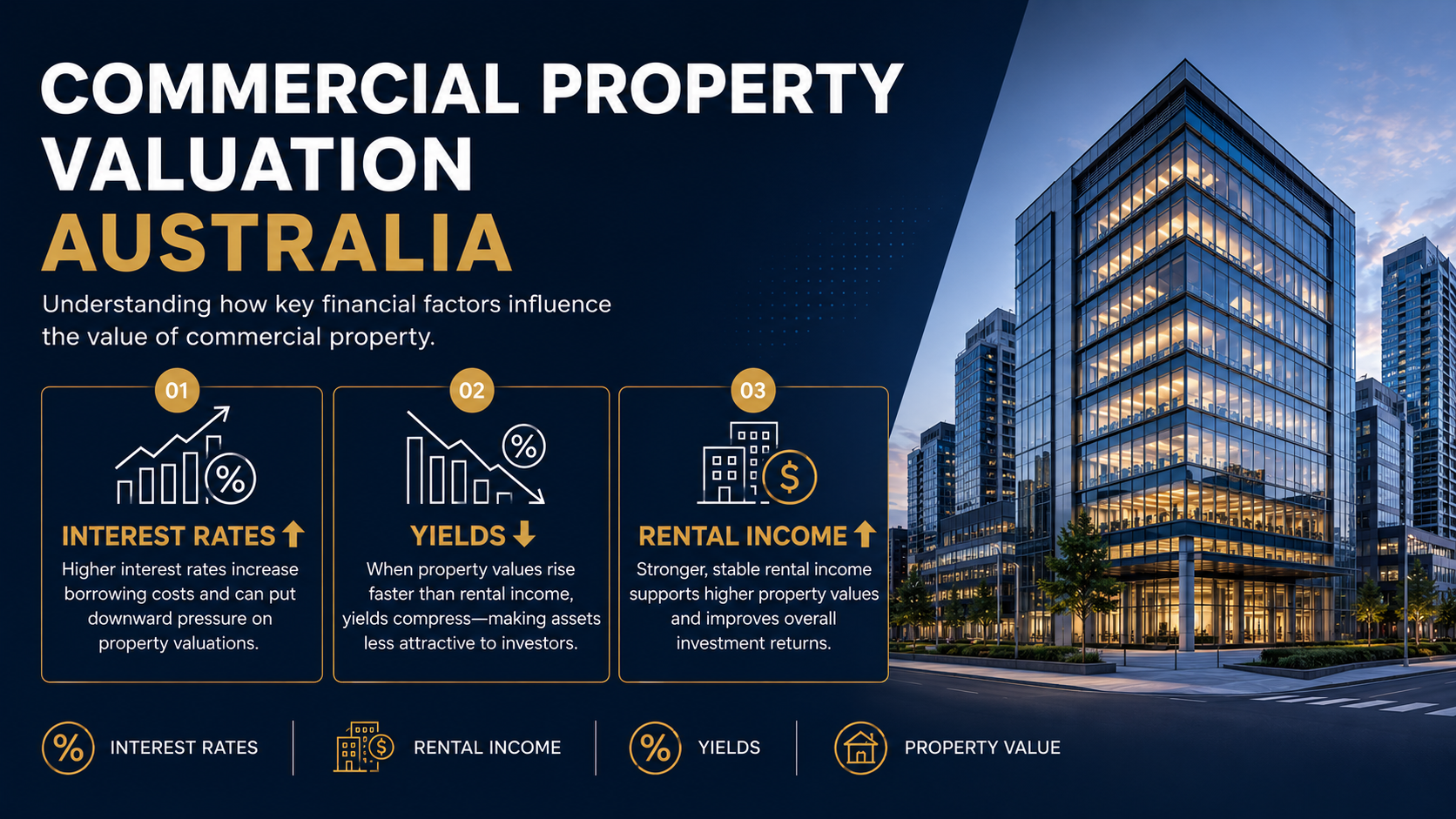
Commercial Property Valuation Australia: How Interest Rates, Yields and Rental Income Affect Property Value
Understanding commercial property valuation in Australia is essential for investors, developers and property owners looking to make informed decisions in the commercial real estate market. Unlike residential property, commercial real estate is heavily influenced by the income a property generates. Rental income, lease terms, tenant quality, market yields and financing conditions can all have a significant impact on how an asset is valued. But how do these factors actually work together?
What Is Commercial Property Valuation?
Commercial property valuation is the process of determining the market value of a commercial asset such as an office building, industrial property, retail centre or medical facility.
One of the most important approaches used in commercial real estate is the income approach, where the property's expected income is used to help determine its value.
This makes rental income and investment yields particularly important for Australian commercial property investors.
Why Rental Income Matters
A commercial property is ultimately an income-producing asset.
A property with strong, reliable rental income can be more attractive to investors because it provides greater income visibility.
1. Factors that can influence rental income include:
- 2. Current rental rates
- 3. Lease duration
- 4. Rental increases
- 5. Occupancy levels
- 6. Tenant quality
- 7. Vacancy risk
- 8. Operating expenses
For example, a property with a long-term lease to a financially strong tenant may be viewed differently from a similar property with short leases and high vacancy risk.
This is why commercial property valuation in Australia goes beyond simply looking at the building itself.
What Is a Capitalization Rate?
The capitalisation rate, commonly called the cap rate, is an important concept in commercial property investment.
It represents the relationship between a property's net operating income and its value.
In simple terms:
Property Value = Net Operating Income ÷ Capitalisation Rate
For example, if a commercial property generates $500,000 in annual net operating income and the market capitalisation rate is 5%, the implied value would be approximately $10 million.
However, market capitalisation rates vary depending on factors such as:
- 1. Property type
- 2. Location
- 3. Tenant strength
- 4. Lease length
- 5. Asset quality
- 6. Market conditions
- 7. Investor demand
How Interest Rates Affect Commercial Property Values
Interest rates can have a major influence on commercial property values in Australia.
When interest rates rise, borrowing costs generally increase. Investors may then require higher returns to compensate for the additional cost of capital and risk.
This can place upward pressure on capitalization rates.
When capitalization rates increase, property values can decline if the property's income remains unchanged.
This is one reason why interest rates and commercial property valuations are closely connected.
The Relationship Between Yield and Property Value
Yield is another important consideration for commercial property investors.
Suppose two properties generate similar levels of rental income, but one trades at a significantly higher yield.
The higher-yielding property may have a lower market value relative to its income, potentially reflecting differences in location, tenant quality, lease security or perceived risk.
Investors therefore need to understand why a property has a particular yield, rather than simply looking for the highest number.
A high yield can sometimes indicate higher risk.
Tenant Quality Can Influence Valuation
A commercial property's tenant can have a significant impact on its perceived investment risk.
A long-term lease with a financially strong tenant can provide greater income security, while a property dependent on short-term or uncertain tenancy may carry greater leasing risk.
Investors often consider:
Who is the tenant?
How long is the lease?
Are there rental increases built into the lease?
What happens when the lease expires?
How difficult would it be to replace the tenant?
These questions can influence both investment demand and commercial property value.
Lease Length Matters
Lease structure is particularly important in Australian commercial real estate.
A property with a secure long-term lease can offer predictable income, which may be attractive to investors seeking stable cash flow.
However, a long lease isn't automatically better.
Investors also need to consider rental growth, lease incentives, upcoming expiries and the property's potential market rent.
The quality of the lease can be just as important as its length.
Location Still Matters
Even with an income-focused valuation approach, location remains a fundamental factor.
A commercial property in a strong location may benefit from:
- 1. Strong tenant demand
- 2. Limited competing supply
- 3. Better accessibility
- 4. Population growth
- 5. Infrastructure investment
- 6. Rental growth potential
For commercial property investment in Australia, understanding the local market is therefore essential.
A property with strong income today may have very different long-term potential from one located in a market with stronger growth fundamentals
Why Valuations Can Change Even When Rent Doesn't
One of the most important concepts for investors to understand is that a property's value can change even when its rental income remains stable.
For example:
Net Income: $500,000
Capitalisation Rate: 5%
Indicative Value: $10 million
If market conditions cause the capitalisation rate to move to 6%, the same $500,000 income would imply a value of approximately $8.33 million.
This demonstrates why commercial property yields, interest rates and valuations are so closely connected.
What Should Commercial Property Investors Look At?
When evaluating a commercial property, investors should consider the complete picture rather than focusing on one metric.
Key factors include:
- 1. Net rental income
- 2. Capitalization rate
- 3. Lease terms
- 4. Tenant strength
- 5. Vacancy risk
- 6. Rental growth
- 7. Location
- 8. Interest rates
- 9. Financing costs
- 10. Supply and demand
- 11. Capital expenditure
Looking at these factors together can provide a more realistic view of the property's potential value and investment risk.
The Future of Commercial Property Valuation in Australia
As Australia's commercial real estate market continues to evolve, investors are becoming increasingly focused on income quality, financing conditions and long-term asset fundamentals.
Interest rates may change. Market yields may move. Tenant demand can fluctuate.
But the fundamental question remains:
How strong, sustainable and valuable is the income generated by the property?
For commercial property investors, understanding this relationship can help them assess opportunities more effectively.
The Bottom Line
Commercial property valuation in Australia is influenced by much more than the physical building.
Rental income, capitalization rates, interest rates, tenant quality, lease structures and location all play a role in determining what an asset may be worth.
For investors, the goal isn't simply to find a property with a high yield.
It's to understand what is driving that yield, how sustainable the income is, and whether the property's value can remain resilient as market conditions change.
Related Commercial Property Guides
Mlina Editorial — Mlina Group helps Australians invest in commercial property through buyer advocacy, education, and asset management. Meet our team.
Ready to Take the Next Step?
Learn more about commercial property investment in our upcoming webinar
Join Our Next Webinar