
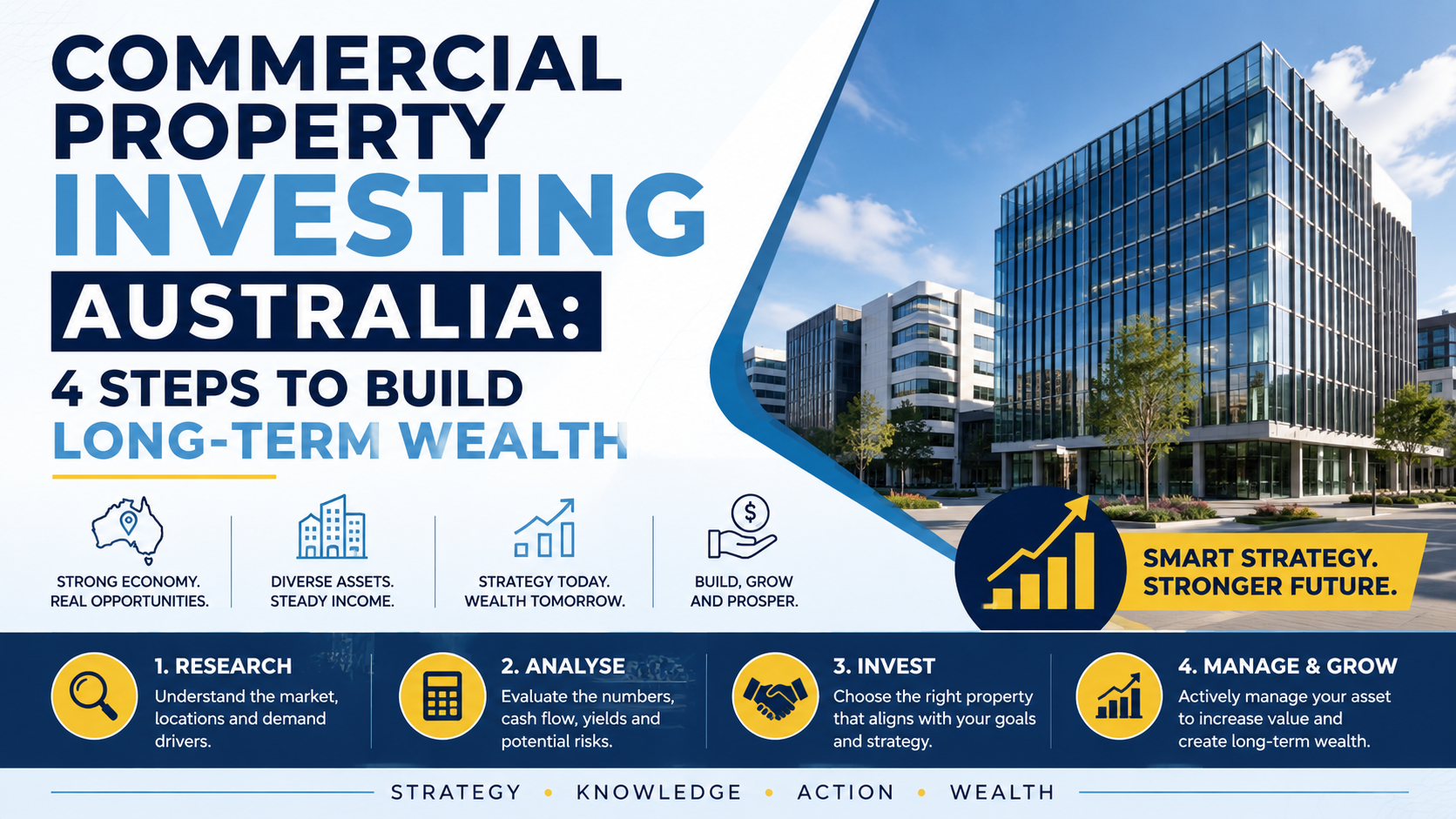
Commercial Property Investing Australia: 4 Steps to Build Long-Term Wealth
Learn how commercial property investing in Australia works, including investment strategy, property valuation, rental income, finance, yields and risk management.
What Is Commercial Property Investing?
Common types of commercial property in Australia include:
- > Industrial and logistics properties
- > Office buildings
- > Retail centres
- > Medical and healthcare properties
- > Warehouses
- > Mixed-use commercial properties
Unlike residential property, commercial real estate is generally driven heavily by rental income, tenant demand, lease terms and business activity.
Understanding these fundamentals is essential before making a commercial property investment.
1. Define Your Commercial Property Investment Goals.
The first step in commercial property investing Australia is establishing clear investment goals.
Are you looking to generate regular rental income?
Are you targeting long-term capital growth?
Are you looking to diversify an existing property portfolio?
Or are you planning to build a larger commercial property portfolio over time?
Your investment objective will influence the type of commercial property you should consider.
For example, an investor prioritising income may focus on a property with a strong tenant, long-term lease and reliable rental cash flow.
An investor focused on capital growth may place greater importance on location, infrastructure, population growth and future demand.
Your investment strategy should determine the property you buy not the other way around.
2. Identify the Right Commercial Property Opportunity
The Australian commercial property market includes a wide range of assets, and each sector has different opportunities and risks.
When evaluating a commercial property investment in Australia, investors should consider several fundamental factors.
Location : Does the location have strong current and future tenant demand?
Tenant Quality: Is the tenant financially stable and capable of maintaining rental payments?
Lease Terms : How long does the lease run? Are there scheduled rental increases? When does the lease expire?
Rental Income : Is the property's income sustainable, and does it reflect current market conditions?
Vacancy Risk : If the existing tenant leaves, how easily could another tenant be found?
Property Fundamentals : Is the building well maintained? Could future capital expenditure affect investment returns?
The goal isn't to find the property with the highest advertised yield.
The goal is to find an asset where income, risk, location and long-term potential work together.
3. Understand Commercial Property Valuation and Yield
Understanding commercial property valuation in Australia is one of the most important parts of the investment process.
Commercial property is often assessed based on the income it generates.
One commonly used measure is the capitalization rate, or cap rate.
A simplified calculation is:
Property Value = Net Operating Income ÷ Capitalization Rate
For example, if a property generates $500,000 in annual net operating income and the market capitalization rate is 5%, the indicative value would be $10 million.
If market yields change, the property's valuation can change even if its rental income remains the same.
This is why commercial property yields, rental income and property valuations are closely connected.
Investors should therefore avoid evaluating an asset based solely on its purchase price or headline rental yield.
4. Structure Your Commercial Property Finance Carefully
Finance plays a major role in commercial property investment Australia.
Interest rates, loan terms, borrowing costs and loan-to-value ratios can all affect the overall investment return.
Before purchasing commercial real estate, investors should understand:
- 1. Purchase price
- 2. Deposit requirements
- 3. Loan-to-value ratio
- 4. Interest rate
- 5. Loan term
- 6. Repayment structure
- 7. Financing costs
- 8. Refinancing risk
- 9. Expected rental income
- 10. Cash flow
A property that appears attractive before financing costs may look very different once interest expenses and other costs are included.
This is why commercial property finance in Australia should be considered as part of the investment strategy from the beginning.
Why Tenant Quality Matters in Commercial Property
A commercial property's tenant can have a significant influence on its investment profile.
A financially strong tenant with a long-term lease may provide greater income security than a property with short-term leases or uncertain occupancy.
Investors should examine:
- 1. Tenant financial strength
- 2. Lease duration
- 3. Rental review provisions
- 4. Tenant concentration
- 5. Lease expiry dates
- 6. Renewal options
- 7. Tenant demand for the location
The property itself is only part of the investment.
The lease and the income attached to it are equally important.
Commercial Property Investment Risks in Australia
Like any investment, commercial property investing in Australia involves risks.
Some of the key risks include:
Vacancy Risk :
Commercial properties can sometimes remain vacant for extended periods, depending on the property type and location.
Tenant Risk :
If a major tenant experiences financial difficulties, rental income may be affected.
Interest Rate Risk :
Higher borrowing costs can reduce investment cash flow and overall returns.
Lease Expiry Risk :
A property's income may change significantly when a major lease expires.
Capital Expenditure :
Commercial buildings can require significant maintenance, upgrades or refurbishment.
Market Risk :
Changes in supply, demand, rental growth and capitalisation rates can affect commercial property values.
Understanding these risks before purchasing can help investors make more informed decisions.
How to Build a Commercial Property Portfolio
Building a commercial property portfolio in Australia is generally a long-term process.
Rather than focusing solely on individual properties, investors should consider how each asset fits into their overall portfolio.
Portfolio considerations can include:
- > Property sector diversification
- > Geographic diversification
- > Tenant diversification
- > Lease maturity diversification
- > Income stability
- > Debt levels
- > Risk exposure
For example an investor may eventually have exposure to industrial, retail and office property rather than relying on a single commercial asset.
The right approach depends on the investor's objectives, financial position and risk tolerance.
Is Commercial Property a Good Investment in Australia?
There is no single answer.
The potential of a commercial property investment depends on the individual asset and its fundamentals.
A strong investment opportunity may combine:
Quality tenant + secure lease + sustainable income + strong location + appropriate purchase price + manageable financing
A property with a high yield but weak tenant demand or significant vacancy risk may be less attractive than a lower-yielding property with stronger fundamentals.
This is why investors should assess risk-adjusted returns, rather than focusing on one number.
The Future of Commercial Property Investment in Australia
The Australian commercial property market continues to change as businesses, consumers and investors respond to economic conditions, technology, infrastructure and demographic trends.
Industrial and logistics property is influenced by supply chains and e-commerce.
Retail property is influenced by consumer spending and population growth.
Office property is influenced by employment patterns and changing workplace requirements.
Healthcare property is influenced by demographics and demand for essential services. These different drivers create opportunities across the commercial real estate market.
For investors, understanding these trends can help identify where future demand may emerge.
The Bottom Line
Commercial property investing in Australia requires more than finding a property with an attractive rental yield.
Successful investment decisions require a clear strategy, detailed financial analysis and an understanding of the fundamentals behind each asset.
The 4 key steps are:
1. Define your investment goals.
2. Identify commercial property with strong fundamentals.
3. Analyze valuation, yield and rental income.
4. Structure finance and manage investment risk carefully.
The goal isn't simply to own commercial property.
The goal is to own the right commercial property, at the right price, with the right income and the right long-term fundamentals.
Related Commercial Property Guides
Mlina Editorial — Mlina Group helps Australians invest in commercial property through buyer advocacy, education, and asset management. Meet our team.
Ready to Take the Next Step?
Learn more about commercial property investment in our upcoming webinar
Join Our Next Webinar